

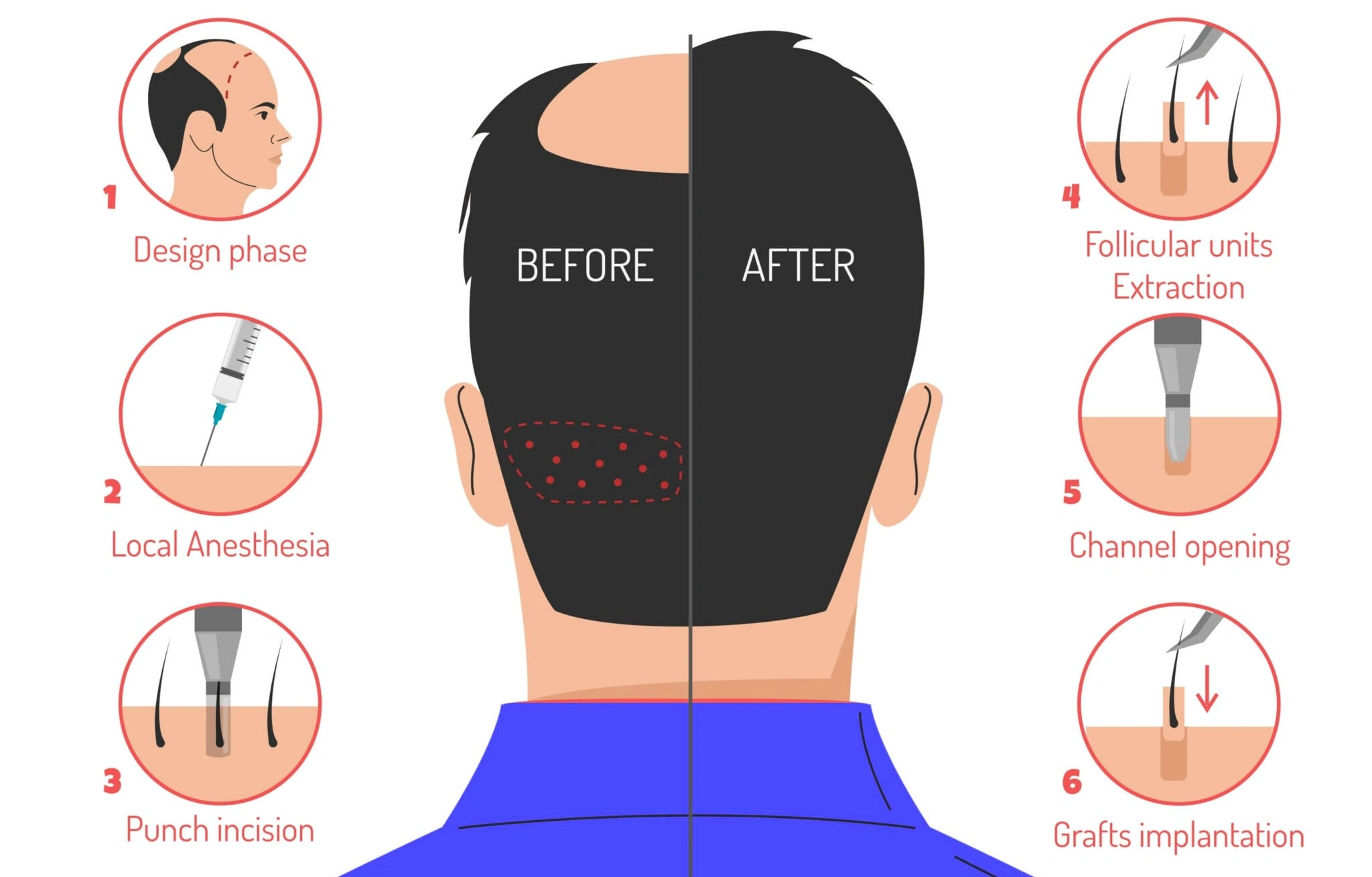
FUE hair transplant is a minimally invasive surgical hair restoration technique where individual hair follicles are harvested from a donor site—typically the back of the head—and implanted into thinning or balding areas. It leaves no linear scar and offers permanent, natural-looking results.
How the FUE Procedure Works Step-by-Step
The FUE procedure is a meticulous surgical journey designed to maximize graft survival and aesthetic harmony.
Donor Area Preparation: The back and sides of the scalp are trimmed short to provide clear visibility of the hair follicular units.
Local Anesthesia: Local anesthesia is administered to ensure the patient remains comfortable and completely pain-free throughout the extraction and implantation phases.
Graft Extraction: Using a specialized micro-punch tool (ranging from 0.6mm to 0.9mm), the surgeon individually scores and extracts healthy follicular units.
Site Creation and Implantation: Tiny recipient micro-channels are carefully opened in the balding zones, followed by the precise placement of each harvested graft to mimic natural hair growth angles.
FUE Hair Transplant Cost in Malaysia
Average Price Range and Cost Per Graft
The hair transplant cost in Malaysia is globally recognized for offering exceptional value without compromising medical standards. On average, total procedures range from RM 8,000 to RM 30,000, heavily dependent on the scale of hair thinning. When calculated per graft, standard FUE typically ranges between RM 3 and RM 12 per graft, positioning Malaysia competitively against regional hubs like Thailand and Western countries.
Additional Fees: Consultation, Medication, and Follow-Ups
Transparent pricing is vital for medical travelers and local residents alike. Beyond the baseline surgical fee per graft, patients should account for auxiliary expenses:
Initial Specialist Consultations: Ranging from complimentary to RM 300 depending on the seniority of the practitioner.
Post-Operative Care Kits: Specialized shampoos, antibacterial sprays, and healing ointments.
Prescription Medications: Short courses of anti-inflammatory drugs, pain relievers, or supportive hair-growth supplements.
Follow-Up Reviews: Frequently bundled into package deals by reputable medical aesthetic centers.
FUE vs. Alternative Hair Restoration Techniques
FUE vs. FUT (Follicular Unit Transplantation)
FUT involves harvesting a linear strip of scalp tissue from the donor zone, which is later dissected into individual grafts under a microscope. While FUT can be faster and slightly cheaper for massive sessions, it leaves a permanent linear scar. FUE extracts individual units directly, avoiding linear scarring and allowing patients to wear short hairstyles comfortably.
FUE vs. DHI (Direct Hair Implantation)
DHI is an evolutionary offshoot of standard FUE. In conventional FUE, the doctor creates recipient holes first and then implants grafts manually using forceps. With DHI, specialized Choi Implanter Pens load and implant the follicle simultaneously, offering tighter control over depth, direction, and density, though typically at a higher price point.
Candidacy and Preparation for FUE in Malaysia
Who Makes an Ideal Candidate for FUE?
An ideal candidate is an individual experiencing pattern baldness (Androgenetic Alopecia), stable hairline recession, or thinning eyebrows/beards who possesses a dense, healthy donor reserve at the back or sides of the head. Good overall health and realistic expectations regarding coverage density are crucial.
Pre-Surgery Guidelines and Medical Evaluations
Prior to scheduling the surgery, patients undergo thorough scalp analysis and blood screening to rule out underlying deficiencies or progressive bleeding disorders. Patients are routinely instructed to cease smoking, avoid blood-thinning medications, and abstain from alcohol for at least one to two weeks leading up to the procedure date.
Recovery, Aftercare, and Results Timeline
What to Expect During the First Two Weeks
The initial recovery phase requires careful adherence to post-op guidelines. Micro-scabs form around the newly planted grafts and donor zone, typically shedding naturally within 7 to 10 days. Mild swelling or pinkness may occur during the first few days, but most individuals resume light desk work and everyday routines within 3 to 5 days.
Timeline for Hair Shedding and New Growth
Patience is essential following a restoration procedure. Around weeks two to four, a temporary phase known as “shock loss” occurs, where the newly transplanted hairs fall out—this is a normal biological reset. Permanent new shaft growth begins to sprout around the 3-to-4-month mark, with full cosmetic density, thickness, and maturation visible between 9 to 12 months.
Clinical Insight: Successful anchoring of grafts occurs within the first 5 to 7 days post-surgery. Touching, scratching, or exposing the scalp to direct, harsh UV rays during this window can compromise the final yield, making strict adherence to clinical aftercare instructions vital.
Choosing the Best FUE Clinic and Surgeon in Malaysia
Key Criteria: MOH Certification and ISHRS Membership
Patient safety depends heavily on selecting a facility accredited by health regulatory authorities. Verify that the performing physician holds valid Letter of Credentialing and Privileging (LCP) status, active registration with the National Specialist Register (NSR), and reputable memberships in global bodies like the International Society of Hair Restoration Surgery (ISHRS).
Overview of Top Hubs: Kuala Lumpur, Penang, and Johor Bahru
Malaysia features advanced medical tourism infrastructure centered primarily around metropolitan hubs. Kuala Lumpur stands out as the premier destination, housing internationally recognized aesthetic specialists, cutting-edge clinical infrastructure, and seamless multilingual support for domestic and international patients.
Frequently Asked Questions About FUE in Malaysia
Is FUE hair transplant permanent?
Yes. FUE hair transplant is permanent. The hair follicles harvested for the procedure are taken from the permanent donor zone at the back of the scalp, which is genetically resistant to the hormone DHT (dihydrotestosterone) responsible for male pattern baldness. Once relocated, these follicles continue to grow naturally for a lifetime.
Does the FUE Procedure Hurt?
The FUE procedure is virtually painless. Local anesthesia is meticulously applied to numb both the donor and recipient areas before the procedure begins. Patients may feel mild pressure or slight vibrations during graft harvesting, but acute pain is effectively prevented, and any minor post-operative soreness is easily managed with mild prescribed analgesics.
Ready to Restore Your Hair?
Take the first step toward a natural, confident look by scheduling a personalized consultation with the expert medical team at GLOJAS Specialist Clinic.